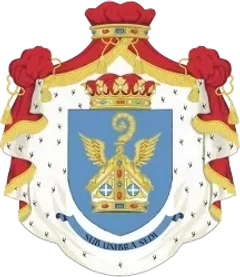
The Sovereign
His Most Reverend Highness Monsignor Giovanni Luca Pietro II
Elected the 91st sovereign of the Principality on XXIX September MMXIX, crowned by an Orthodox prelate XXVIII December MMXIX. A Prince-Abbot who carries the monastic vocation into governance.
Sovereignty
The office of the Prince-Abbot
The Principality of Sabourg is governed by its Prince-Abbot, a religious man whose election is the most solemn act of the state. The Prince-Abbot unites two dignities: the spiritual authority of the monastic order and the civil sovereignty of the state.
By the ancient custom that has sustained the abbatial state since 1261, the Prince-Abbot is always a man of religious vocation. He is not merely a figurehead presiding over secular institutions; he is the living embodiment of the Principality's religious foundation.
The current sovereign carries the title as the 91st unbroken successor to the abbots who first brought the monastic rule to these lands. His motto, and the motto of the realm itself, is Sub umbra sedi — "I sat in the shade" — a passage from Psalm 91, speaking of refuge under the Most High.
The Monastic Vocation
Why the Prince-Abbot is a religious man
A throne rooted in faith
The Principality was born from a monastic charter. When monks received governance of these lands in 1261, they did not separate sacred office from civil duty. The Prince-Abbot, therefore, embodies that original union. He rules not as a secular despot, but as a guardian of both spiritual and temporal order.
The traditions of the abbatial order
For more than seven centuries, the abbots (and now the Prince-Abbot) have stood in direct succession to those who founded the state. This continuity is not symbolic; it is constitutional. The monastic vocation is the foundation upon which all institutions rest.
A symbol of transcendent governance
In an age of competing material interests, the Principality declares that its sovereign answers to a law higher than mere appetite. The Prince-Abbot is bound by vows that predate and supersede all political convenience. He governs Sub umbra sedi.
Government
The structures of the state
The e-Cabinet
The immediate council of the Prince-Abbot, comprising ministers and advisors responsible for the day-to-day administration of the state and its engagement with the modern world.
Monastic Council
Guardians of the spiritual and canonical life of the Principality, the monastic council ensures that all governance remains rooted in the religious traditions that founded the state.
Crown Council
A senior council convened in counsel to the Prince-Abbot on the affairs of the state, as defined by the Principality's constitutional tradition.
Council of State
A body of state counselors responsible for legal and administrative matters, ensuring that all acts of government conform to the Principality's own constitutional order.
Chivalry & Recognition
The Equestrian Order of St Martin
The Equestrian Order of St Martin is the Principality's sovereign order of chivalry, bestowing recognition upon those who have served the state, advanced its diplomatic mission, or demonstrated exceptional devotion to the ideals it represents.
Membership in the order is a civilian honour, distinct from government office, reflecting the Principality's ancient tradition of knightly fellowship rooted in monastic and ecclesiastical precedent.